
When I went vegetarian a decade ago, I found it pretty painless to pass on most animal-based dishes. Burgers? Plant-based patties were abundant and, for the most part, delicious. Poultry? Easy: vegan chicken nuggets tasted just like the real deal. Pork? I’d never been a huge fan in the first place. My one weakness was sushi. No matter where I looked, I just couldn’t find a satisfying veggie alternative to my favorite form of seafood.
It’s only now, 10 years later, that new food science innovations could finally make the vegan, whole-cut fish of my dreams a reality. This year several alternative protein companies are launching or already offering their first crop of plant-based filets, promising to replicate the taste and texture of real fish. But why is it so hard to make a good piece of vegan salmon in the first place?
It turns out that flavor is the easy part. The rather specific taste common to fresh fish comes mostly from a combination of molecules that scientists already know how to replicate in a lab: long-chain fatty acids, such as omega-3s and omega-6s, which give fish their oily quality and taste, and volatile carbonyls, which lend a lighter, almost melonlike flavor. The real challenge of vegan fish is nailing the mouthfeel. “When the texture is enjoyable, you can take the dish in many directions,” says Guy Vaknin, a chef who heads four vegan restaurants in New York City, including Beyond Sushi. “It’s a great canvas.”
“Fish has a very special texture,” says Atze Jan van der Goot, a food process engineer at Wageningen University & Research in the Netherlands. Most cuts of fish actually contain several layers of short-fiber muscle, which are held together with thin bands of connective tissue and fat. Within each layer, bundles of microscopic muscle fibers are arranged like the teeth of a comb, all pointing in the same direction. It’s this structure that gives cooked fish its unique flaky quality.
But most processes for making meat substitutes aren’t designed to mimic muscle fiber. Instead they aim for a far simpler consistency: that of ground meat, which can be pressed into burger patty, sausage or nugget form. “I think a lot of meat is consumed via nugget-type products,” van der Goot says, “especially in the U.S.”
The food-processing technique that best achieves nugget texture in vegetarian meat substitutes is called extrusion. It involves grinding raw food material, such as grains, vegetable proteins and various additives, into fine particles and then forcing the resulting “dough” through a tube under high pressure. As it squeezes through this opening, the food slurry is cooked simultaneously by added steam and the heat of its own friction.
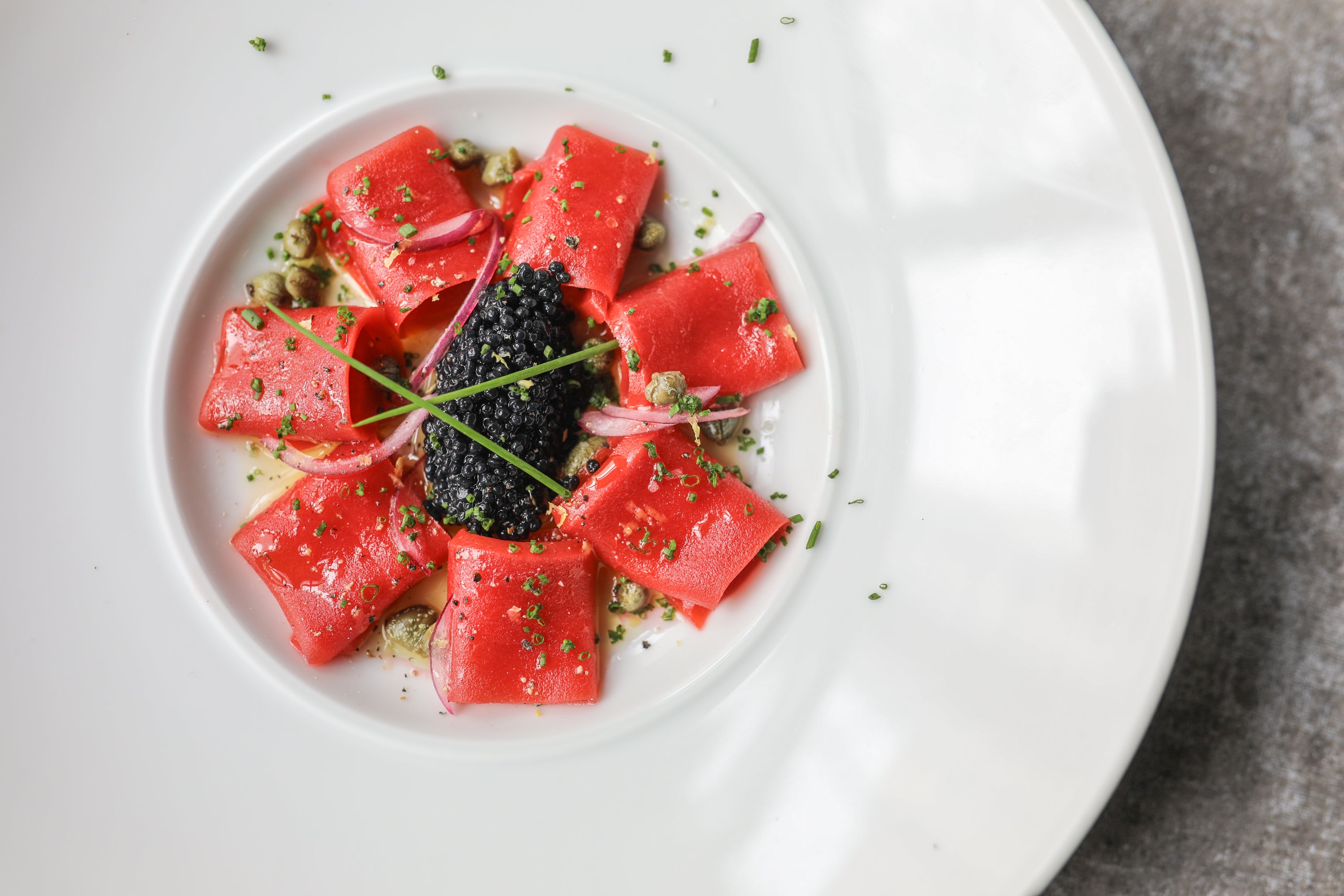
Like the Star Trek “replicator,” extruders can squirt out an astronomical range of prepackaged edibles—everything from Cheerios to cheese puffs to chewing gum relies on this process. The catch is that such products all have a similar texture, and they can’t be extruded raw. The process generates so much heat that it denatures, or unravels, most of the available protein molecules in the extruded material, rendering it somewhat shapeless. This is perfectly fine if people want to purchase a vegan crab cake. But it presents a challenge if they’re shopping for a raw fish substitute in order to re-create the experience of, say, biting into uncooked salmon crudo or searing a juicy tuna steak.
Luckily, food scientists are now finding creative new ways to re-create fish’s intricate sheets of parallel muscle fiber. One such technique is called directional freezing. This process capitalizes on the fact that ice tends to form in a certain direction—starting from the coldest point and moving outward. It also tends to adhere to itself, freezing in pure crystals of H2O. Some food researchers have applied directional freezing to blocks of gel made from edible algae. As the gel freezes, the water inside it solidifies into needlelike ice structures, creating a matrix of thousands of tiny tubes. This perforated gel makes a great scaffolding for uncooked faux fish.
That’s the strategy that New School Foods, a Canadian alternative meat start-up, is using to craft its plant-based raw salmon and tuna filets. “It’s basically like a directional sponge,” says Auke de Vries, New School Foods’ lead food materials scientist. Adjusting the size of the gel matrix or tweaking its freezing temperature can yield differently sized or shaped channels, “which is important because that’s the main driver of texture,” de Vries says.
Once the scaffolding is in place, the food science researchers can fill the channels by injecting them with whatever mixture of protein, fat and flavor they want. The options include 100 percent plant-based proteins, such as soy, pea or gluten, and—potentially—actual animal cells cultured in the lab. They can also add volatile flavor compounds that might otherwise break down in a precooked product. “We’re not married to any one ingredient,” says New School Foods founder Chris Bryson.
But there’s more than one way to skin a vegan catfish. Another method gaining traction in the alternative seafood world is 3-D printing. Revo Foods, a plant-based seafood manufacturer in Vienna, uses 3-D food printers to build smoked salmon filets from the ground up with carefully constructed layers of pea protein, algal extracts and omega-3 fatty acids.
If all of these techniques sound elaborate, it’s because they are. But the technology to make vegan meat and seafood is getting cheaper by the day, and its proponents believe the environmental benefits far outweigh the production hassle. “The impact that overfishing and harmful fishing practices have on vulnerable ocean ecosystems is very serious,” says Birgit Dekkers, a food scientist and co-founder of the Dutch plant-based meat company Rival Foods.
According to the Food and Agriculture Organization of the United Nations, overfishing and habitat destruction have depleted more than one third of global fish stocks. Not only does this wreak havoc on aquatic ecosystems, it can even contribute to global climate change by reducing the number of species available to store carbon. “The overall carbon footprint of ocean trawling is equivalent to the carbon footprint of the entire aviation industry,” Bryson says.
Persuading more people to switch to sustainable plant-based seafood isn’t going to fix climate change. But it could be a step toward ensuring that there are always plenty of fish in the sea.